Tag Archives: higher education

AI Search Rewards What Audiences Already Trust

New research shows AI engines build their answers on credible, independent sources. For universities, that is an invitation to tell their stories better. 

By William “Skip” Hidlay

Consider the new world of AI-curated search: A high school junior types a prompt into ChatGPT as the student starts researching where to apply for college.

Which universities are best for marine biology, and why? Which provide research opportunities for freshmen? Who are the most distinguished marine biologists on their faculty?

The answers arrive in seconds. The AI platform names a handful of universities, providing a summary of what makes each one stand out, what research opportunities they provide to students, and a list of what AI identified as their top faculty members in marine biology.

The student may never visit a single university website. Whatever the student learns about university marine biology programs in that moment comes from what the AI platform chose to include in its summary of search results.

AI-curated search results represent the new front door for every university and academic health center. An estimated 68% of Google searches in the United States ended without a click in the first four months of 2026, according to a SparkToro study.

Increasingly, whatever answers AI provides is where the search ends.

So, what do AI engines read and how do they decide what to summarize about your university, your health system, and your brand? New research offers an encouraging answer.

What AI Reads

For its May 2026 “What Is AI Reading?” report, the media relations and strategy firm Muck Rack analyzed more than 25 million links cited by ChatGPT, Claude, and Gemini across 17 industries. It found that 84% of citations came from what it categorizes as earned media.  Paid and advertorial content accounted for 0.3% of AI summaries. News releases made up about 1%.

Interestingly, under the earned media category, journalism and traditional news coverage alone accounted for 27% of cited links, and more than half of that coverage had been published within the previous 12 months. That pattern has held across three editions of the study since July 2025, with earned media ranging from 82% to 89%.

These results validate the continued need for maintaining strong media relations teams and continuing to pitch stories about groundbreaking new research and other news about your university and academic health center to traditional media outlets.

But I think the most important finding from the Muck Rack data is subtler for university brand, communications, and marketing leaders.

Muck Rack counts an organization’s own content, what I like to call “brand storytelling” and “owned media” content, as earned media when an AI engine cites it to answer someone else’s question.  The Muck Rack study found that “corporate blogs and content” accounted for 24% of citations, nearly matching the proportion of earned media AI summaries from journalism publications. When AI answers a question about the organization itself and cites content from its website, Muck Rack counts this as owned media, which made up another 13.7% of the broader earned media category.

In other words, an expert-written article or a fact-based, journalistic-style feature story on a university’s own website can earn its way into AI answers on nearly the same terms as traditional news coverage. What gets the story read and cited by AI are facts, a named expert, and real-life experiences, without a marketing sales pitch.

What People Trust

What’s also interesting is that, when it comes to information about health and wellness, AI engines are essentially mirroring human behavior in what they choose to highlight. People learn from doctors, other clinicians, and health care providers as well as from other people who’ve had similar health challenges and experiences.

In April 2026, the Pew Research Center published a survey of 5,111 U.S. adults on where Americans get health information. Health care providers remain the most common source, at 85%. But 66% said they also learn from other people going through similar experiences, and about half say they struggle to know which information is accurate.

Health is a revealing case, but the pattern holds for any high-stakes decision, including where to go to college: People want expertise, want to hear from someone who has been there, and aren’t entirely sure what to believe.

For university leaders, the point here is that AI-curated search rewards what audiences already trust: credible experts telling real, fact-based stories, without a marketing sales pitch.

Proof From a Brand Storytelling Newsroom

I saw this play out four years ago, before Generative AI platforms burst onto the scene, when I served as chief communications and marketing officer at the Ohio State University Wexner Medical Center. To help build the university health system’s brand as a destination for innovative research and advanced clinical care, we developed and launched a web storytelling platform and content engine in 2022 called Ohio State Health & Discovery.

Every health story we produced carried a named clinical expert’s byline or told an in-depth profile or feature about one. We chose topics by finding questions people were asking Google that had few credible, readable answers.

Our goal was to build, over time, a deep ecosystem of brand stories and content that would surface in Google searches. What we didn’t realize is that this also would set us up for future success in the new era of AI-curated search.

One example of how our approach worked: People wanted to know whether mouthwash kills the mouth’s healthy bacteria, and search results returned mostly dense academic papers. An expert from Ohio State’s College of Dentistry answered the question in plain language, and we kept updating the story as new questions emerged. It drew more than 121,000 views through March 2026, about 110,000 of them from organic search.

As AI grew in importance as a gatekeeper of search results, Health & Discovery content appeared in more than 13,500 Google AI Overviews in 2025, and sessions from AI search engines grew 207% from the year before. None of these results came from paid placements. Our stories earned AI citations the way Muck Rack’s data suggests: through expertise, specificity, facts, and brand stories only we could tell.

What Universities Can Do Now

Universities hold an advantage most brands would envy: deep benches of genuine experts and a steady supply of human stories from students, faculty, alumni and, at academic medical centers, patients.

Here are three moves you can make now to put that advantage to work:

Put names on the work. Give bylines to faculty and staff experts and state their credentials consistently wherever they appear. When using communications staff and freelance writers to write news and feature stories, establish their authority and credibility with author bios that provide their experience and credentials.

Answer the questions people actually ask. Find the high-volume questions in your fields that lack credible, readable answers, and let your experts answer them.

Keep earning coverage. Recency matters to AI engines, so a steady cadence of credible brand journalism news and feature stories beats one big hit a year.

The temptation in the AI era is to produce more content, faster, using AI itself to write the content. The evidence points the other way. Generic, AI-produced content gets summarized away by the AI engines with citing the source.

Authentic human-centered stories, told by people who know what they are talking about, are what AI reads and cites. And what human audiences believe.

The more the machines summarize, the more the human story matters and breaks through the clutter.

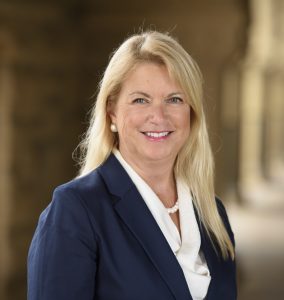
Editor’s Note: We are delighted to welcome Skip Hidlay as PRG’s newest senior associate. Most recently Skip served as chief communications and marketing officer for the University of Chicago Medicine from 2016-2020 and for The Ohio State University Wexner Medical Center from 2020-2026. He has more than 30 years of experience in senior leadership roles across healthcare and news media. He leverages data-driven content marketing, brand storytelling, and multi-channel media strategies to build brands, drive growth and create engagement. In addition, Skip is helping us and our clients think more deeply about technology developments and the applications and implications of AI. 
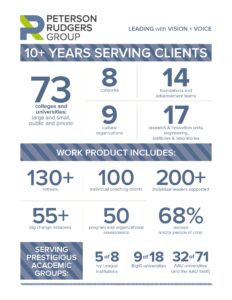
 

10 Years At A Glance

Julie, Steve and I have enjoyed marking PRG’s tenth anniversary this month. In some ways it’s hard to believe the consulting firm we envisioned (while brainstorming around a northern Michigan farmhouse table) has grown this much in scale and scope! We are privileged to work with clients whose organizations create enormous positive impact in their states, in our country, and around the world. We’re also grateful for our talented staff and expert collaborators who expand our capacity and make our work ever more effective. To everyone who has come along with us on this journey: Thank you.

A Decade In: What We’ve Learned About Leadership and Change in Challenging Times

By Lisa M. Rudgers, Julie A. Peterson, and Steve Kloehn

Peterson Rudgers Group is celebrating a major milestone. Just over 10 years ago, we hung out our consulting shingle with an aim to support leaders working in higher education and other mission-driven enterprises. We had spent decades in-house as higher ed leaders ourselves, and we shared an unshakeable belief in higher education’s tremendous societal impact. And yet, though we couldn’t have predicted it back at the farmhouse table in northern Michigan where we first designed PRG’s business plan, the 10 years that followed have been the most volatile and disruptive in the history of American higher education.

Lisa Rudgers

Lisa M. Rudgers

This decade? It’s been a lot. A pandemic. A national racial reckoning. The long-predicted enrollment cliff. Structural deficits that no longer yield to the old fixes. Culture wars, legal battles, disrupted federal research funding, barriers to international students and a steady erosion of public confidence in the enterprise itself. Conflicts on campus and in front of Congress.

Through it all, we have seen leaders tested to their core. External stakeholders — from elected officials to prospective students and families to the tax-paying public — are demanding change. Meanwhile, faculty and staff are fearful of what change will mean to the quality of their work and scholarship, and concerned that deep change may adversely affect the very mission of the institution.

Yet we engage our work with optimism and hope. That optimism is driven by college presidents, provosts and leadership teams who have shown extraordinary resilience, creativity and commitment in the face of these challenges. Drawing on our experiences with effective leaders across the country and our roles as expert advisors and counselors, we offer a few best practices for leading in this moment.

JuliePeterson-headshot

Julie A. Peterson

The leader’s ability to develop and communicate a clear, inspiring and inclusive vision — instead of, or in complement to, a problem statement — is essential. A “red light” without a “green light” does not motivate people over the long haul. Change driven primarily by fleeing a threat is exhausting, and it produces resistance and burnout rather than movement or momentum. Fear will certainly get people’s attention, and it may create a sense of urgency. But sustained over time, it is more likely to paralyze a community than to mobilize one. A leader’s job is to set an inspiring course and move the whole community in that direction. What is the positive outcome we are aiming for in the change we want to drive? Great leaders help people see that better future, show them they have a place in it, and invite everyone to create that future together.

In existential times, executive teams must function at the very highest level. Higher education is a talent business. Big endowments, beautiful buildings and blue-chip reputations all fall into disrepair without a strong leadership team to move them forward. The reverse is also true: a talented team working well together can accomplish something akin to the miraculous in a surprisingly short time. As the sector’s challenges have increased in scale and intensity, it has become ever more critical to build a strong, skilled and complementary senior team and to cultivate an “institutionalist” culture within it. By that we mean there is an expectation that the team will work together toward shared goals, not divisional or individual goals alone. Also, the team should be clear about its guiding principles: how team members will work together and show up for each other. Low-functioning teams can break when the going gets tough, but an executive team that is highly skilled and collaborative can help to build institutional resilience and renewal.

Steve Kloehn

Steve Kloehn

The academy needs to change substantially in ways that it is not adept at, but there are proven change models that can help.  Change has never come easily to colleges and universities, and rapid change is entirely outside our institutional DNA. The good news is that leading through change is not magic. It is a learned skill, well studied and systematized. There are many schools of change management, and we have found John Kotter’s 8-Step Model especially useful in our work with higher ed leaders. Three of his points deserve more attention than they get:

  • Kotter insists on winning both heads and hearts. If you grew up in the academy, you were trained to win arguments, and a great many leaders believe in their souls that once they win the argument, everyone will follow. They will not. Having the facts is necessary and insufficient. Every time you communicate, ask people to join you in something important and appeal to their emotions as well as their logic. What matters most is the “why.” If a change is not advancing the mission, it is not worth doing, and if it is advancing the mission, say so explicitly and with compelling storytelling. Do not assume anyone will connect those dots on your behalf.
  • Leaders who struggle to make change under-communicate their vision by a factor of 10. You have not said it too many times; you have almost certainly said it too few.
  • As the change process gets underway, identifying early wins and celebrating them can help generate momentum for more and greater change. Research shows that one of the greatest motivators in the workplace is progress toward a worthy goal.

Financial pressures are accelerating, but mission-focused strategy is key. Across-the-board cuts only drive toward mediocrity. Boards are anxious in 2026, and their questions are pointed: What are you doing to control costs, and by what date will the budget be in the black? What parts of the organization are no longer fulfilling a current need? Where do we have “sludge” and redundancy? Where is the dashboard of metrics we should be tracking? These are all critical questions, but building institutional resilience is not only about cost cutting and efficiency measures. Key strategic investments and redesign in areas of strength and innovation are equally important. It’s a “both and.”

Where are the new programs, markets and revenue sources — based on our existing assets — that will strengthen the university’s mission and value proposition? How can our schools, colleges and administrative units work together more collaboratively in ways that are more than the sum of their parts? These are not challenges university leadership teams can solve on their own. Leaders must meaningfully engage stakeholders from across the enterprise in program redesign, prioritization and strategy development. Even though the community may feel it is more equitable to cut X percent a year across the board each year in the face of stagnating state budgets, necessary tuition restraint and decreasing federal support, in the end it will only be “less” rather than stronger and ever more mission focused.

The president’s healthy relationship with the board is more important than ever before. In a period of this much uncertainty, the relationship between a president and the governing board is more consequential than ever. Without a strong, supportive board behind them, presidential tenures are rocky and, sometimes, failures. As with every important relationship, it takes time, effort and intentionality. A few ways we’ve seen good leaders work most effectively with their boards: informing and engaging the board, rather than “managing” it; real deliberation and dialogue time in meetings rather than show-and-tell; and educating trustees sufficiently about ambient conditions, institutional trends and academic decision processes. Engaging board members in active discussion around meaningful questions and decisions is critical, as is positioning those conversations at the right altitude: What are the governance questions at play? Systems and structures can help, too. Leadership teams can carefully consider how to staff effectively for board support, design effective meeting agendas and communicate effectively with board members between meetings.

Shared governance is an asset, not an obstacle. We believe higher ed leadership teams are well served to develop strong and authentic relationships with faculty governance bodies. There’s no denying there are often challenges among academic and administrative leadership team mandates and the shared governance model: It takes additional time, it means a layered approach to final decision making, and there can be a lack of clarity or shared understanding about decision rights. We get it. But faculty governance bodies are a testing ground for ideas, and their members are usually elected by peers precisely because they care and are willing to do the work. Having a productive relationship means one-on-one time as well as attendance at formal meetings, patient listening, and a genuine willingness to address legitimate concerns. The payoff: faculty representatives have influence with their colleagues that no administrator can manufacture. Bringing a major initiative to the appropriate body for an advisory endorsement, even when that body holds no formal authority over the matter, builds the foundation you will need for implementation and helps you avoid time-sucking detours. Working with shared governance costs time. Working around it costs more.

Great leaders exhibit moral courage. Decide what you stand for before the crisis arrives. We have watched a great many leaders try to navigate the narrow channel between the shoals by taking the political temperature and steering accordingly. It almost never works. It is not possible to make everyone happy, and the attempt reads as exactly what it is. The more durable approach is to know your institution’s priorities, values and principles, be able to argue clearly why they are worth defending, and shore up support among trustees, faculty leaders, donors and other key partners before you need it. A courageous stand accompanied by a clear and consistent rationale can earn respect even from those who disagree. The hard part is that values can often be in conflict, and the trade-offs differ by institution. Those conflicts are far easier to think through in advance than in the middle of a crisis, and the leaders who have done that thinking are visibly steadier when the moment comes.

What has not changed, and will not, is the mission. Historian and author James Tobin once described a university as “the purpose made permanent.” Amid all the disruption of the last decade, we believe the most essential thing any of us can do is stay focused on higher education’s “why”: knowledge, understanding, opportunity and social mobility, and service for the public good. When the mission stays in focus, decisions and direction do too.

A Growing Team of Seasoned and Talented Associates

One distinctive aspect of the Peterson Rudgers Group model is the ability to tap into a distinguished and diverse group of team members, associates and senior advisors who have deep experience in leadership roles at a wide range of colleges and universities. We have continued to add to this pool of seasoned leaders whose wisdom directly benefits our clients — most recently with addition of Sonya Malunda as our newest senior advisor and the appointment of Lisa Connolly as the newest member of our administrative team.

Lisa Lapin

Lisa Lapin

This spring we welcomed Lisa Lapin as our newest senior associate. Lisa served as Vice President for Communications at the J. Paul Getty Trust, the world’s largest cultural and philanthropic organization dedicated to the visual arts. There she led marketing, media relations, internal communication and public affairs, raising the regional, national and international profile of Getty and its Conservation Institute, Research Institute and Getty Library, grant-making Foundation, and two world-renowned fine art museums in Los Angeles. Prior to joining the Getty Trust, Lisa served as Stanford University’s chief communications officer for 10 years and led communications at the University of California, Davis for nearly a decade. In those roles she was a national leader on cutting-edge digital and strategic communications as well as issues and crisis management. Lisa launched her career as an award-winning journalist and editor at leading newspapers including the New York Times, Los Angeles Times, San Jose Mercury News and The Sacramento Bee. She holds an MLA from Stanford University and a BA in journalism from the University of Southern California.

Over the past several months, we were delighted to add four valued colleagues as senior associates: Laurie Fenlason, Alida Miranda-Wolff, Angela Paik and Marisa Quinn.

Continue reading →